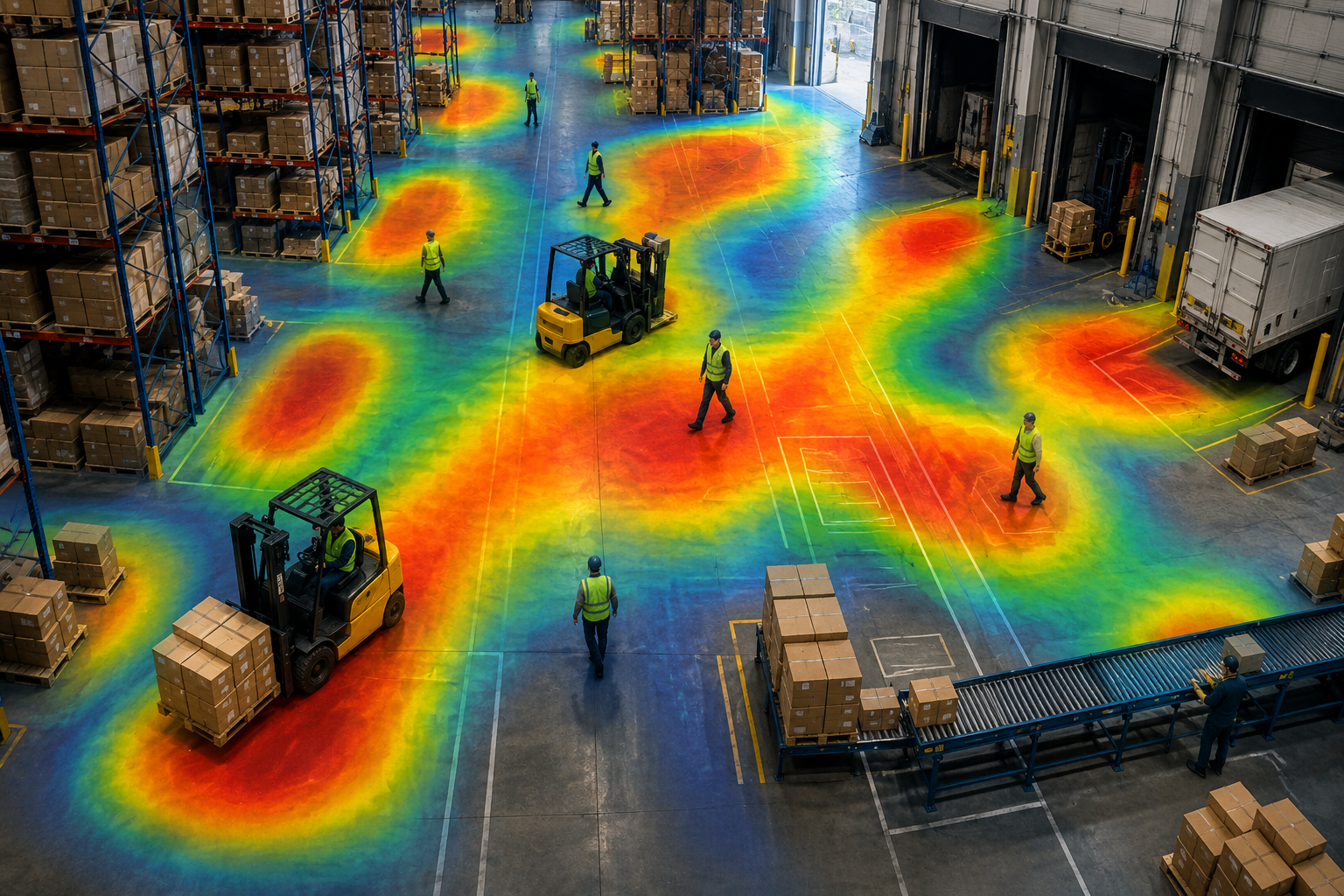
Forklift and pedestrian safety is often discussed as a training issue. Training matters, but many recurring conflicts are created by the environment: blind corners, interrupted walkways, temporary staging, congested docks, changing rack layouts, and production demands that force people into shared space.
Watch how people compensate
Employees are skilled at adapting. They pause at a corner, listen for equipment, step around a pallet, or cross outside a marked route because the formal path no longer matches the work. Those behaviors may keep the operation moving, but they also indicate that the traffic system is relying on individual judgment.
A walkthrough should focus on where the intended route breaks down. The most important observations are often the places where people have created unofficial rules to make the layout usable.
Review the conflict points
- Blind intersections and rack-end visibility
- Pedestrian routes that end before the destination
- Staging that narrows aisles or blocks sight lines
- Dock areas where drivers, forklifts, and pedestrians mix
- Battery charging or equipment parking that changes traffic flow
- Peak-volume periods that create temporary congestion
Design for real movement
Traffic controls should reflect actual travel patterns, not only the original floor plan. When a process changes, the route should be reviewed again. A painted line is not a control if employees must leave it to perform the job.
Where possible, separate people and powered equipment physically. Where separation is not practical, improve visibility, define right-of-way, control speed, reduce unnecessary crossings, and make the expected behavior obvious at the point of conflict.
Use observation across shifts
A warehouse can look controlled during a quiet walkthrough and very different during shift change, receiving peaks, or trailer congestion. Reviews should sample the operation when pressure is highest. That is when temporary workarounds and communication gaps become visible.
The strongest traffic system is not the one that looks best on a diagram. It is the one that remains understandable and usable when the warehouse is busy.